
What a Real Financial Plan Covers
A plan built around your life rather than a product. Start wherever you are, and we’ll show you what’s missing.
What a Real Financial Plan Covers
Request a ConsultationFinancial planning is the process of organizing what you have, protecting it, and directing it toward what you actually want.
A real plan covers six areas: where you stand today, protection, investments, tax, retirement income, and legacy: what you leave behind. It is a process that continues, not a document you receive once.
THREE KEY POINTS
- Planning is not only for the wealthy. That belief is the most common reason people delay it.
- A plan should tell you what to do next, not just where you stand.
- Six areas make up a complete plan. Most people have three or four covered and don’t know which.
Regardless of where you’re at, we’ll help you plan for your future.
-
01
I don’t know where to start
Most people don’t. There’s a short version and it takes about thirty minutes.
-
02
I’m getting close to retirement
Life moves from people at work to money at work, and the questions change with it.
-
03
I own a business
Two balance sheets, one plan. Usually the largest piece and the least covered.
-
04
I’m sorting out my estate
Who receives what, and who decides if you can’t.
What a real financial plan actually covers
Most people have pieces. A 401(k) here, some life insurance there, a will drafted years ago and never revisited. What they don’t have is a view of how those pieces work together, or which one is missing.
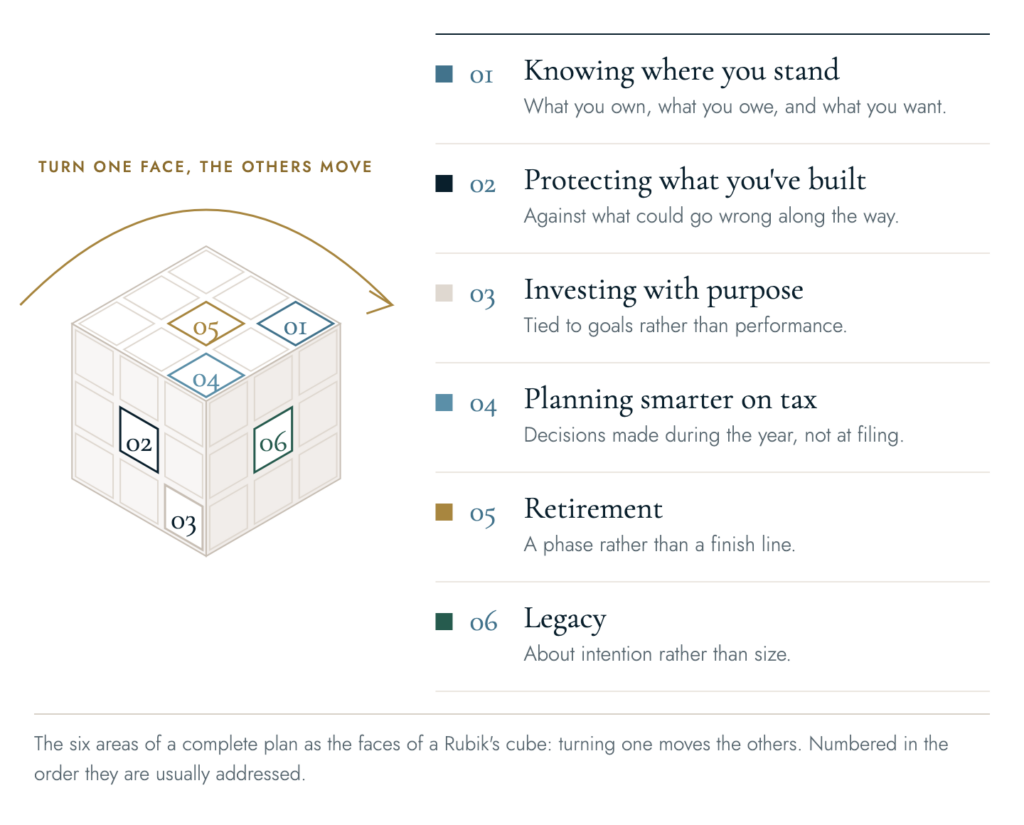
We organize planning around six areas. Knowing where you stand. Protecting what you’ve built. Investing with purpose, tied to goals rather than performance. Planning smarter on tax. Retirement as a phase rather than a finish line. And legacy, which is about intention rather than size.
Very few people have all six covered. The value of the first conversation is usually finding out which ones aren’t.
How we work: the Sagient Blueprint, in three tiers
The Sagient Blueprint is our planning process, offered in three tiers. Comprehensive is our premier concierge process for high-net-worth individuals and families. Foundational is for households whose planning needs are growing. Roadmap is for people at the beginning, who want a clear plan and the right first steps.
Every tier starts with a picture of where you actually are, moves through the six areas in the order that matters for your situation, and ends with a plan you can act on rather than a binder you file.
What makes the Blueprint different is the sequencing. We bring behavioral finance into the plan, looking at behavior alongside numbers, because the reason plans fail is rarely the math. It is usually that the plan asked someone to do something they were never going to do.
You are not handed off. The advisor you meet is the advisor you keep: a team leader who will coordinate with your attorney, CPA, and any other team members you might need, rather than working around them.
Financial planning in El Segundo, the South Bay, Southern California and Hawaii
We work with families and business owners across El Segundo, Manhattan Beach, Torrance, the South Bay and all of Southern California, as well as Hawaii. And we can work with you wherever you are.
Our office is at 200 N. Pacific Coast Highway in El Segundo. First conversations are usually thirty minutes, by video or in person.
The six pillars, shown as a Rubik’s cube
Questions people ask.
- What is financial planning?
-
Financial planning is the process of organizing what you own, protecting it against what could go wrong, and directing it toward what you actually want. A complete plan covers six areas: your current position, protection, investments, tax, retirement income and legacy. It is an ongoing process rather than a document you receive once.
- What does the financial planning process involve?
-
It starts with a values-based discussion about what matters most to you, which is where our approach differs. Then comes an honest picture of where you stand: what you own, what you owe, and what you want. From there each of the six areas is examined in the order that matters for your situation, and the result is a set of decisions you can act on. The plan is then revisited and modified as needed when your circumstances change over time.
- What is the difference between financial planning and wealth management?
-
Wealth management generally refers to managing investments. Financial planning is broader. It covers protection, tax, retirement income, estate and cash flow alongside investments, and asks what the money is for before deciding how it should be invested. Many firms offer both; the distinction is where the conversation starts.
- How much money do you need to work with a financial planner?
-
Less than most people assume, and the belief that planning is only for the wealthy is the most common reason people delay it. Planning has the most leverage when decisions are still ahead of you rather than behind you. What matters more than a balance is whether you face choices that are difficult to reverse.
- How often should a financial plan be reviewed?
-
When something changes, such as a new job, a child, a house, a business, a death in the family, or a move to another state. Absent those, at Sagient we conduct reviews at least annually. Plans drift quietly: beneficiary designations, insurance amounts and savings rates all fall out of step with a life that has moved on.
Related Topics on What a Real Financial Plan Covers
All Financial TopicsReady to talk it through?
Send us a few details and an advisor will reach out within one business day to schedule time. There's no obligation — just a conversation about where you stand and what makes sense next.
"*" indicates required fields
Related News

Sagient Mentorship Program Addresses Advisor Shortage
August 28, 2026Sagient’s Emerging Advisor Development Leader Partnership Program takes a hands-on approach to addressing the industry’s growing advisor shortage. By pairing newer advisors with experienced professionals, the program provides real-world exposure, mentorship, and guidance designed to accelerate development, build confidence, and improve long-term success and retention.

Respecting Tradition While Moving Forward
July 26, 2026Sagient CEO Paul Karlitz shares how lasting success comes from balancing innovation with enduring values. Drawing parallels to iconic brands that have evolved over time, he explains why firms must embrace change, invest in continuous improvement, and stay true to the client-first principles that define their culture and long-term success.

Institutional memory gives experienced advisors an edge in volatile markets. This is what gets lost without it.
June 24, 2026Sagient advisor Kathleen Adams shares why experience and perspective are critical advantages when helping clients navigate periods of market excitement and uncertainty.