
The Three Tax Buckets and How to Use Them
What you keep matters more than what you earn. Most of that is decided before December.
The Three Tax Buckets and How to Use Them
Request a ConsultationTax planning is the practice of arranging income, investments and withdrawals to reduce the tax paid over a lifetime rather than in a single year.
It covers which accounts hold which assets, when income is recognized, how gains and losses are managed, and how withdrawals are sequenced in retirement.
THREE KEY POINTS
- Tax preparation records what happened. Tax planning changes what happens.
- Where an asset is held can matter as much as which asset you chose.
- Most meaningful tax decisions have to be made during the year, not at filing.
Regardless of where you’re at, we’ll help you plan for your financial future
-
01
My income jumped this year
Timing decisions matter most in an unusual year, and the window is short.
-
02
I’m approaching retirement
The gap between retiring and claiming benefits is often the most valuable planning window you get.
-
03
I hold concentrated stock
Equity compensation and concentrated positions carry tax questions that need sequencing.
-
04
I just want to stop overpaying
The most common starting point, and usually the easiest to improve.
What is the difference between tax preparation and tax planning?
Tax preparation is a record of decisions already made. By the time a return is filed, almost every opportunity to change the outcome has closed.
Tax planning happens during the year and across years. It asks which account an investment should sit in, whether to realize a gain this year or next, whether to convert to a Roth while income is low, and how a withdrawal will interact with other income.
Both matter, and they are different jobs. We coordinate with your CPA rather than replacing them. The plan and the return should be built from the same assumptions.
What is asset location, and why does it matter?
Asset allocation is what you own. Asset location is which account you own it in, and it is the less discussed of the two despite being straightforward to act on.
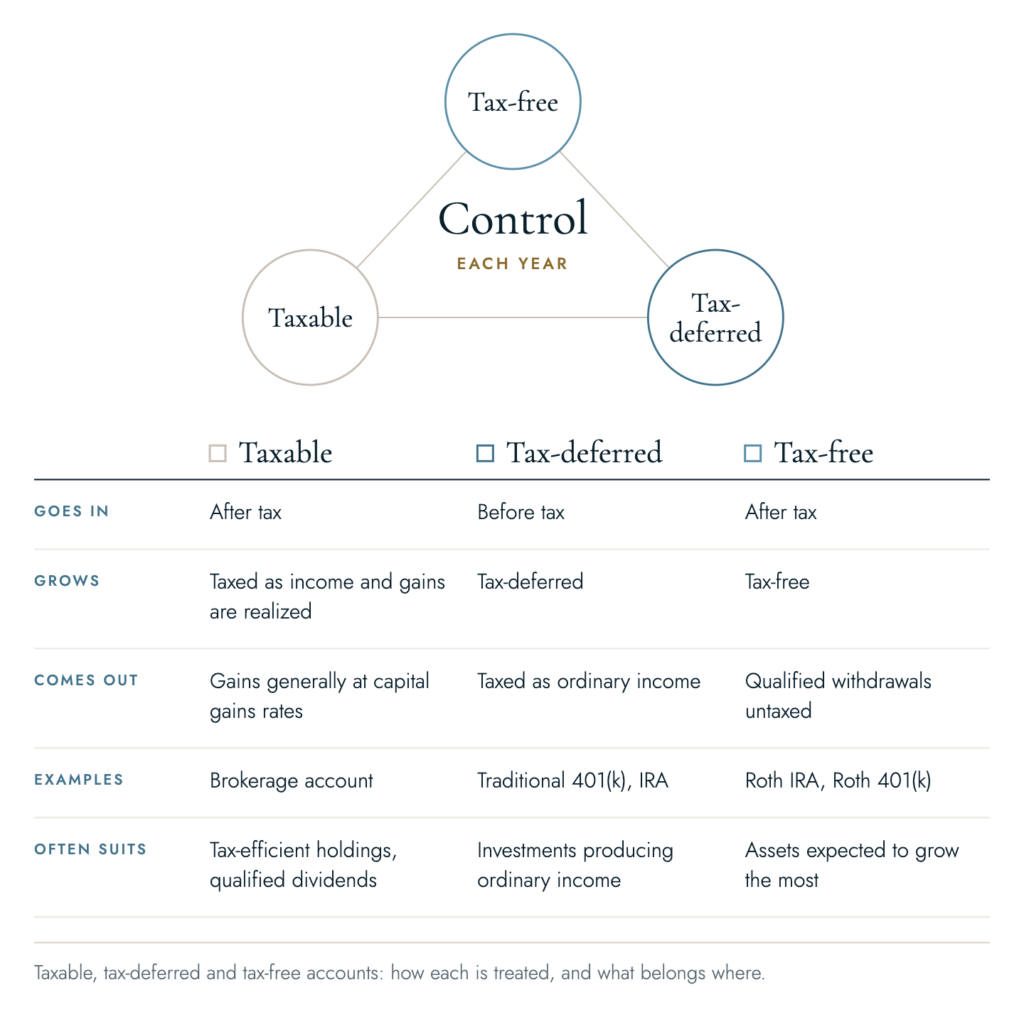
The principle is that investments generating income taxed at ordinary rates are generally better held in tax-deferred accounts, while assets expected to grow substantially may be better in a Roth, where the growth is not taxed on withdrawal. Tax-efficient holdings can sit in taxable accounts with less cost, and assets that throw off qualified dividends or long-term capital gains are often better in a taxable account, where those are taxed at lower federal rates.
Getting this wrong does not show up as a loss. It shows up as a slightly smaller result every year, which compounds quietly over decades.
How does tax loss harvesting work?
Selling an investment at a loss realizes that loss, which can offset gains elsewhere and, within limits, ordinary income. The proceeds are reinvested in something similar but not substantially identical, so the exposure is maintained.
The constraint is the wash sale rule, which disallows the loss if a substantially identical security is bought within thirty days either side of the sale. This catches people more often than expected, particularly across accounts and with automatic reinvestment switched on.
Done systematically rather than in December, it is a genuine and repeatable benefit. Done carelessly, it creates the appearance of a benefit and a disallowed loss.
When is a Roth conversion worth considering?
When you expect to face higher rates later than you do now. The clearest example is the period between retiring and claiming Social Security or reaching required distribution age, when taxable income is often at its lowest point in decades.
Converting in measured amounts, filling a bracket rather than crossing into the next, turns an unusually low-income year into a long-term advantage. Converting too much in one year usually costs more than it saves.
Conversions also interact with Medicare premium calculations and other income-linked thresholds, which is why they should be modeled rather than estimated.
What should I be doing before December?
Several decisions close at year end: realizing gains or losses, charitable giving, retirement plan contributions in some cases, and any conversion for the current year. Reviewing these in the final quarter is common, and reviewing them in the third quarter is better.
The larger point is that a year with unusual income (a bonus, a business sale, an option exercise, a low-income year between jobs) is where planning has the most leverage. Those years are visible in advance far more often than people act on.
None of this is tax advice for your situation. It is the set of questions worth putting to your CPA, and worth putting to them before the year closes rather than after.
The three tax buckets
Questions people ask.
- What is tax loss harvesting?
-
Selling an investment at a loss to offset gains elsewhere, then reinvesting in something similar but not substantially identical to maintain exposure. The wash sale rule disallows the loss if a substantially identical security is repurchased within thirty days either side of the sale.
- What is the wash sale rule?
-
A rule disallowing a claimed loss if you buy a substantially identical security within thirty days before or after the sale. It applies across accounts, including retirement accounts and a spouse’s accounts, which is where people most often trip over it inadvertently.
- What is asset location?
-
Which type of account holds which investment. Income-generating assets taxed at ordinary rates generally suit tax-deferred accounts; high-growth assets may suit a Roth; tax-efficient holdings work in taxable accounts. It is distinct from asset allocation and easier to change.
- What is tax-efficient investing?
-
Structuring a portfolio to reduce the tax drag on returns through asset location, low-turnover holdings, deliberate management of gains and losses, and coordinating withdrawals. It does not mean avoiding tax; it means not paying more of it than the strategy requires.
- Should I do a Roth conversion?
-
Possibly, if you expect higher rates later than you face now. The window between retiring and claiming Social Security is often the most favorable. Conversions are taxable in the year made and can affect Medicare premiums, so the amount and timing should be modeled rather than estimated.
- Are financial advisor fees tax deductible?
-
For most individuals, no. The federal deduction for investment advisory fees was suspended from 2018, and current federal law has made that permanent. Certain fees connected to a business or specific income-producing assets may be treated differently. Confirm with your CPA.
- How does California tax investment income?
-
California taxes capital gains as ordinary income, with no preferential rate. Combined with federal treatment, this raises the value of asset location and of timing decisions for California residents relative to residents of states without income tax.
- Do you provide tax advice?
-
No. Sagient does not provide tax or legal advice. We plan around tax consequences and coordinate with your attorney and CPA so that the plan and the return are built from the same assumptions, but the tax advice itself comes from your tax professional.
Related Topics on The Three Tax Buckets and How to Use Them
All Financial TopicsReady to talk it through?
Send us a few details and an advisor will reach out within one business day to schedule time. There's no obligation — just a conversation about where you stand and what makes sense next.
"*" indicates required fields
Related News

Sagient Mentorship Program Addresses Advisor Shortage
August 28, 2026Sagient’s Emerging Advisor Development Leader Partnership Program takes a hands-on approach to addressing the industry’s growing advisor shortage. By pairing newer advisors with experienced professionals, the program provides real-world exposure, mentorship, and guidance designed to accelerate development, build confidence, and improve long-term success and retention.

Respecting Tradition While Moving Forward
July 26, 2026Sagient CEO Paul Karlitz shares how lasting success comes from balancing innovation with enduring values. Drawing parallels to iconic brands that have evolved over time, he explains why firms must embrace change, invest in continuous improvement, and stay true to the client-first principles that define their culture and long-term success.

Institutional memory gives experienced advisors an edge in volatile markets. This is what gets lost without it.
June 24, 2026Sagient advisor Kathleen Adams shares why experience and perspective are critical advantages when helping clients navigate periods of market excitement and uncertainty.