
Turning Savings Into a Paycheck That Lasts
You spent forty years building it. Now you graduate from people at work to money at work, and the question is how to spend it without running out.
Turning Savings Into a Paycheck That Lasts
Request a ConsultationRetirement income planning is the process of turning savings into a paycheck that lasts.
The priorities are not running out of money and keeping up with inflation and your personal costs: medical care, family, and the money you want to enjoy. It covers which accounts you draw from and in what order, how much you can take each year, when to claim Social Security, and how to protect against a bad market early in retirement. Accumulation and decumulation are different problems.
THREE KEY POINTS
- The order you withdraw from accounts can change how long the money lasts, sometimes by years.
- Sequence of returns: a poor market in your first few years of retirement does more damage than the same market later.
- Retirement is not a date. It is a phase that may run thirty years or more.
Regardless of where you’re at, we’ll help you plan for your future.
-
01
I’m about ten years out
Still building, but close enough that the decisions start to matter.
-
02
I’m within five years
This is when sequencing, tax and Social Security timing need real answers.
-
03
I just retired
The first few years set the pattern. Getting the withdrawal order right matters most now.
-
04
I’m already drawing income
Plans drift. Reviewing the rate and the order is usually overdue.
How much income will I actually need?
The common rule of thumb is around 80% of pre-retirement income, but the number is less useful than the exercise behind it. Some costs fall: commuting, saving for retirement itself, often the mortgage. Others rise, particularly healthcare and, for many people, travel in the early years.
A more useful approach is to split spending into what is essential and what is discretionary. Essential spending is what your reliable income sources should cover: Social Security, any pension, annuity income. Discretionary spending is what your portfolio funds, and it is the part you can flex when markets are poor.
That split does more work than any percentage rule. It tells you how much guaranteed income you actually need, which is the decision underneath most of the others.
Which accounts should I draw from first?
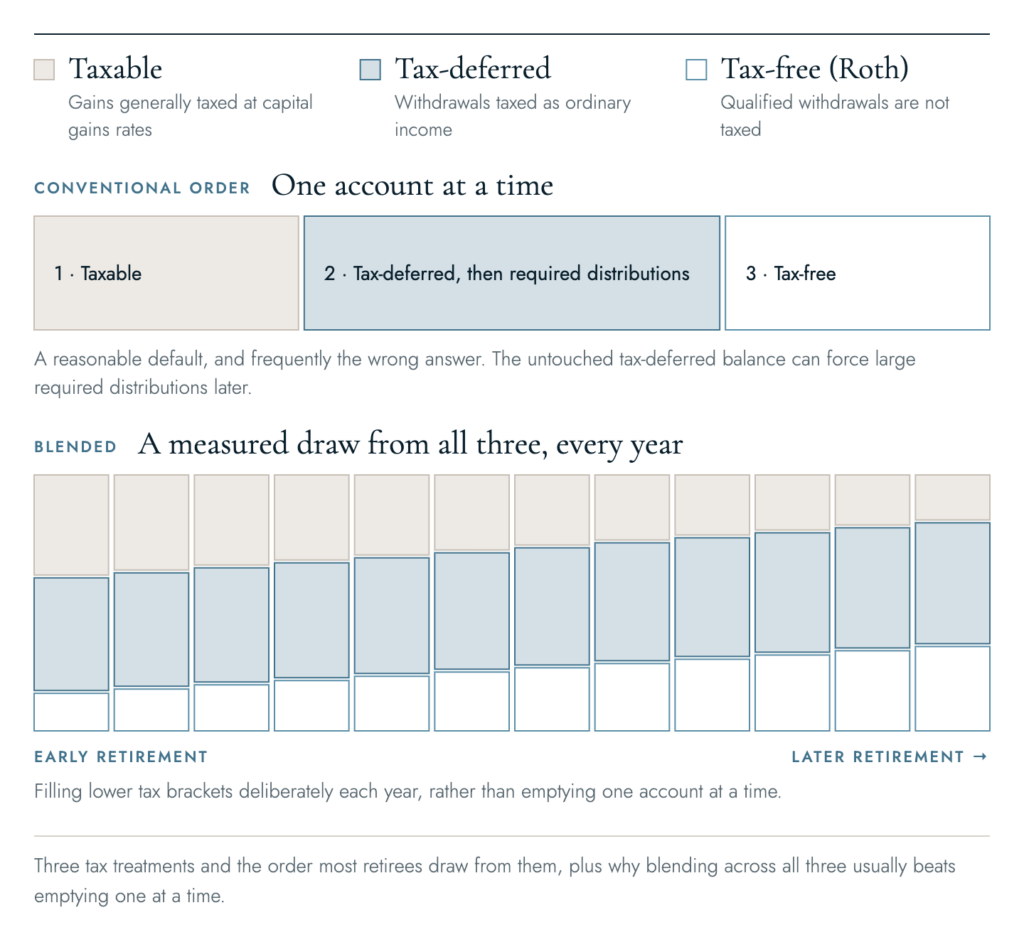
Most people hold three tax treatments: taxable accounts, tax-deferred accounts like a traditional 401(k) or IRA, and tax-free accounts like a Roth. Which you draw from, and in what order, changes your tax bill every year of retirement. The key is having more than one bucket to draw from, which gives you options and flexibility.
The conventional order is taxable first, then tax-deferred, then Roth last. It is a reasonable default and frequently the wrong answer. Drawing entirely from taxable accounts early can leave a large tax-deferred balance that forces high required distributions later, sometimes pushing you into a higher bracket than you were in while working.
The better approach is usually to blend, filling lower tax brackets deliberately each year rather than emptying one account at a time. This is where planning earns its keep, and it is worth modeling rather than guessing.
What is sequence of returns risk?
It is the risk that poor market returns arrive early in retirement rather than late. Two retirees can experience identical average returns over thirty years and end up in very different places depending on when the bad years happened.
The reason is that withdrawals compound the damage. Selling assets to fund living costs in a falling market locks in losses that a portfolio never fully recovers from. The same downturn ten years later, when withdrawals have already been funded from growth, does far less harm.
The defenses are practical rather than clever: hold enough in cash and short-term assets to avoid selling into a decline, keep flexibility in discretionary spending, and avoid retiring on the assumption that the first five years will be normal.
Should I consider a Roth conversion?
A Roth conversion means moving money from a tax-deferred account into a Roth, paying tax now so that future growth and withdrawals are tax-free. It can make sense when you expect to be in a higher bracket later, or when you want to reduce future required distributions.
The window that gets most attention is the period between retiring and claiming Social Security, when income is often at its lowest. Converting in measured amounts during those years, filling a bracket rather than exceeding it, is a common approach.
It is not automatically beneficial. Paying tax early is a real cost, and conversions can affect Medicare premiums and other income-linked calculations. The math depends on your circumstances and should be modeled with your CPA.
When should I claim Social Security?
Claiming early reduces the monthly benefit permanently; delaying increases it. The breakeven point typically falls somewhere in the late seventies to early eighties, which means the decision is partly about expected longevity and partly about what else you have to draw on.
For married couples it is more complicated and more consequential, because survivor benefits depend on the higher earner’s claiming decision. Delaying the higher earner’s benefit raises the income the surviving spouse receives for the rest of their life.
There is no universally right answer, and the calculators online rarely account for tax interaction or the survivor question. It is worth working through properly once rather than approximately several times.
The withdrawal order, and what each account costs you in tax
Questions people ask.
- What is a good monthly retirement income for a couple?
-
It depends entirely on where you live and what you spend. A more useful question is what your essential monthly costs are, and whether Social Security and any pension cover them. If they do, your portfolio is funding discretionary spending, which is a far more comfortable position than the reverse.
- What percentage of my income should I save for retirement?
-
Commonly cited guidance is 15% of gross income including any employer match, starting as early as possible. The percentage matters less than the duration. Someone saving 10% from 25 typically ends up ahead of someone saving 20% from 40. If you are starting late, the number needs to be higher.
- What is the 4% rule, and does it still work?
-
It is a research finding that a portfolio withdrawing 4% in year one, adjusted for inflation, historically lasted 30 years in most scenarios. It is a useful reference point, not a plan. It assumes a particular portfolio, ignores taxes and fees, and does not flex with markets. Treat it as a starting figure to test, not a rule to follow.
- Does California tax retirement income?
-
California does not tax Social Security benefits, but it does tax withdrawals from tax-deferred accounts and pensions as ordinary income, and it has no preferential rate for capital gains. This affects where retirement income is best drawn from and is worth modeling with your CPA.
- What is a retirement bucket strategy?
-
Dividing assets by when you will need them: short-term cash for the next few years of spending, medium-term bonds, long-term growth assets. The purpose is behavioral as much as financial: it means a market fall does not threaten money you need soon, which makes it easier to leave the growth portion alone.
- When do required minimum distributions start?
-
Under current law, required distributions from most tax-deferred accounts begin at age 73 for those born between 1951 and 1959, and at 75 for those born in 1960 or later. Rules have changed several times in recent years, so confirm the current position rather than relying on older guidance.
- Can I retire at 60?
-
It depends on whether your income sources cover your spending in the years before Social Security and Medicare are available. That gap is the part most people underestimate, particularly healthcare costs between 60 and 65. It is often achievable, but the bridge needs planning rather than hoping.
- Should I pay off my mortgage before retiring?
-
It reduces essential monthly spending, which is valuable. But it also means using liquid assets to pay off relatively cheap debt, and liquidity matters more in retirement than people expect. There is no universal answer; it depends on the rate, your tax position, and how much flexibility you have elsewhere.
Related Topics on Turning Savings Into a Paycheck That Lasts
All Financial TopicsReady to talk it through?
Send us a few details and an advisor will reach out within one business day to schedule time. There's no obligation — just a conversation about where you stand and what makes sense next.
"*" indicates required fields
Related News

Sagient Mentorship Program Addresses Advisor Shortage
August 28, 2026Sagient’s Emerging Advisor Development Leader Partnership Program takes a hands-on approach to addressing the industry’s growing advisor shortage. By pairing newer advisors with experienced professionals, the program provides real-world exposure, mentorship, and guidance designed to accelerate development, build confidence, and improve long-term success and retention.

Respecting Tradition While Moving Forward
July 26, 2026Sagient CEO Paul Karlitz shares how lasting success comes from balancing innovation with enduring values. Drawing parallels to iconic brands that have evolved over time, he explains why firms must embrace change, invest in continuous improvement, and stay true to the client-first principles that define their culture and long-term success.

Institutional memory gives experienced advisors an edge in volatile markets. This is what gets lost without it.
June 24, 2026Sagient advisor Kathleen Adams shares why experience and perspective are critical advantages when helping clients navigate periods of market excitement and uncertainty.