
Wills, Trusts and Probate in California
Deciding who receives what, and who decides for you if you can’t. We help you get it right, and keep it current.
Wills, Trusts and Probate in California
Request a ConsultationEstate planning is the process of deciding who receives your assets, who makes decisions if you become unable to, and how both happen with the least delay and cost.
It usually involves a will, one or more trusts, powers of attorney, healthcare directives and beneficiary designations. It is not only about what happens after death.
THREE KEY POINTS
- A will alone does not avoid probate. In California, that matters more than most people expect.
- Beneficiary designations generally take priority over your will for the accounts they cover. Reviewing them is often the fastest fix available.
- An estate plan is not a one-time document. It should be reviewed consistently, and of course when your life changes.
Regardless of where you’re at, we’ll help you plan for your future.
-
01
I have children under 18
Guardianship is the decision most parents delay longest, and it has the fewest good defaults.
-
02
I own a business
Probably your largest asset and the one least covered by a standard will.
-
03
My parents are aging
Helping without overstepping starts with a conversation, not a document.
-
04
I’ve been putting this off
Most people have. Here is the shortest path from nothing to something workable.
What is an estate, and what does estate planning cover?
Your estate is everything you own (property, accounts, insurance, business interests, personal belongings) and everything you owe. If you own anything at all, you have an estate. The question is only whether you have decided what happens to it.
Estate planning answers three questions. Who receives what. Who is in charge of making that happen. And who makes decisions on your behalf if you are alive but unable to. Most people think only about the first.
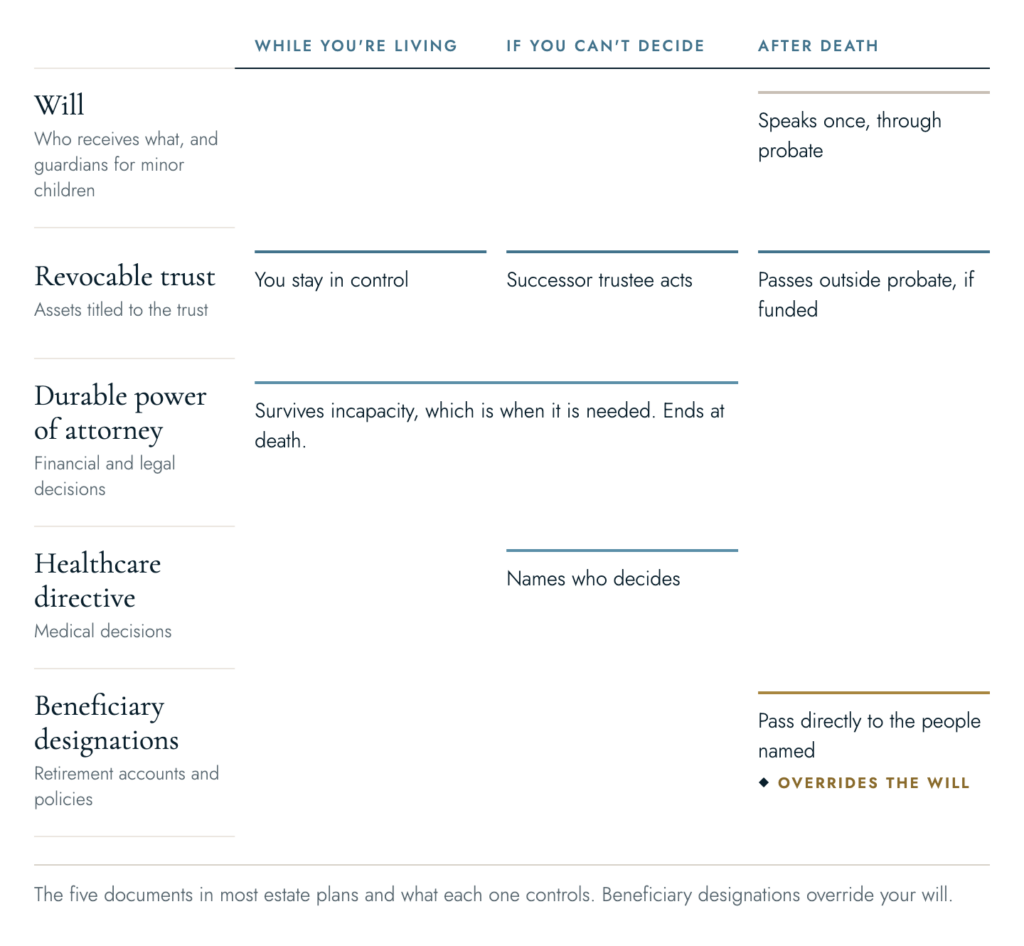
A complete plan generally includes a will, one or more trusts, a durable power of attorney, a healthcare directive, and up-to-date beneficiary designations on every account and policy.
Estate planning or estate tax planning?
They are different questions. Estate planning decides who receives what and who acts for you, and it applies to everyone. Estate tax planning asks whether your estate could owe tax and how to reduce it. That matters for people who are already high-net-worth, and for those on track to become so.
Many people don’t know what is in their estate, or how it could put them in a taxable position. The usual surprises are the value of a home, personally owned life insurance, cars, art and jewelry, and an inheritance received along the way.
Do I need a trust, or is a will enough?
A will directs who receives your assets. A trust holds those assets and can pass them on without going through the court process. In California that is a meaningful difference.
A revocable trust can be changed during your lifetime. You keep control, and the assets remain part of your taxable estate. An irrevocable trust generally cannot be changed. You give up control, and in exchange the assets may sit outside your estate for tax purposes.
Neither is better. Revocable is the more common starting point for families concerned with probate and privacy. Irrevocable comes into play when estate tax exposure or asset protection is the driver.
What is probate, and how do you avoid it in California?
Probate is the court process for validating a will and transferring what it covers. It is public, it takes time, and in California statutory fees are calculated on the gross value of the estate rather than the equity in it.
That is why avoiding probate gets more attention here. The common approaches are a properly funded revocable trust, current beneficiary designations, and titling property so it passes directly.
The word doing the work is ‘funded.’ A trust that exists on paper but never had assets transferred into it does not avoid probate. This is the most common and most avoidable gap we see.
Who makes decisions if you can’t?
This is the part of estate planning that has nothing to do with death, and the part most likely to be needed. Without documents naming someone, your family may need a court to appoint one.
A durable power of attorney authorizes someone to handle financial and legal matters; durable means it survives incapacity, which is when it is needed. A healthcare directive names who makes medical decisions.
If you have aging parents, these are usually the documents to ask about first. They are less confronting than a conversation about inheritance.
What does it cost, and when should you start?
Cost varies with complexity. What is worth knowing is that the cost of not planning is rarely quoted, and in California it is often the larger number once probate fees and delay are counted.
On timing, the right moment is whenever something changes: marriage, a child, buying property, starting or selling a business, moving states. Not a particular age or net worth.
Plans also go stale. Beneficiary designations made a decade ago may name someone you would no longer choose.
The five core documents
Questions people ask.
- Is estate planning the same as a will?
-
No. A will is one document within an estate plan. A complete plan usually also includes a trust, a durable power of attorney, a healthcare directive, and current beneficiary designations.
- How much does estate planning cost?
-
It depends on complexity. The more useful comparison is against the cost of not planning. In California, probate fees are calculated on gross estate value rather than your equity, which is often the larger number.
- When should I start estate planning?
-
Today is always better than tomorrow for planning. The usual triggers are life changes rather than a particular age: marriage, a child, buying property, starting or selling a business, or moving states are all triggers.
- What estate planning documents do I need?
-
Most plans include five: a will, a revocable trust, a durable power of attorney, a healthcare directive, and current beneficiary designations. Not everyone needs all five.
- What is the difference between a revocable and irrevocable trust?
-
A revocable trust can be changed during your lifetime; assets stay in your taxable estate. An irrevocable trust generally cannot be changed, and the assets may sit outside your estate for tax purposes.
- What happens if I die without a will in California?
-
State law decides who inherits, using a fixed order that may not match what you would have chosen. The court also appoints an administrator and may decide guardianship for minor children.
- Is my estate plan still valid if I move states?
-
Generally yes, but it may not work as intended. States differ on community property, probate and estate tax. A move is one of the clearest triggers for a review.
- How often should I review my estate plan?
-
When your life changes, though a review every three to five years catches things you would not think to flag. Beneficiary designations fall out of date most often.
- Should my 18-year-old have estate documents?
-
Yes, and it is a little-known step. At 18 your child is a legal adult, so you no longer have automatic authority over their medical or financial decisions. A durable power of attorney and a healthcare directive fix that. If they attend college in another state, make sure the documents will be recognized there.
Related Topics on Wills, Trusts and Probate in California
All Financial TopicsReady to talk it through?
Send us a few details and an advisor will reach out within one business day to schedule time. There's no obligation — just a conversation about where you stand and what makes sense next.
"*" indicates required fields
Related News

Sagient Mentorship Program Addresses Advisor Shortage
August 28, 2026Sagient’s Emerging Advisor Development Leader Partnership Program takes a hands-on approach to addressing the industry’s growing advisor shortage. By pairing newer advisors with experienced professionals, the program provides real-world exposure, mentorship, and guidance designed to accelerate development, build confidence, and improve long-term success and retention.

Respecting Tradition While Moving Forward
July 26, 2026Sagient CEO Paul Karlitz shares how lasting success comes from balancing innovation with enduring values. Drawing parallels to iconic brands that have evolved over time, he explains why firms must embrace change, invest in continuous improvement, and stay true to the client-first principles that define their culture and long-term success.

Institutional memory gives experienced advisors an edge in volatile markets. This is what gets lost without it.
June 24, 2026Sagient advisor Kathleen Adams shares why experience and perspective are critical advantages when helping clients navigate periods of market excitement and uncertainty.